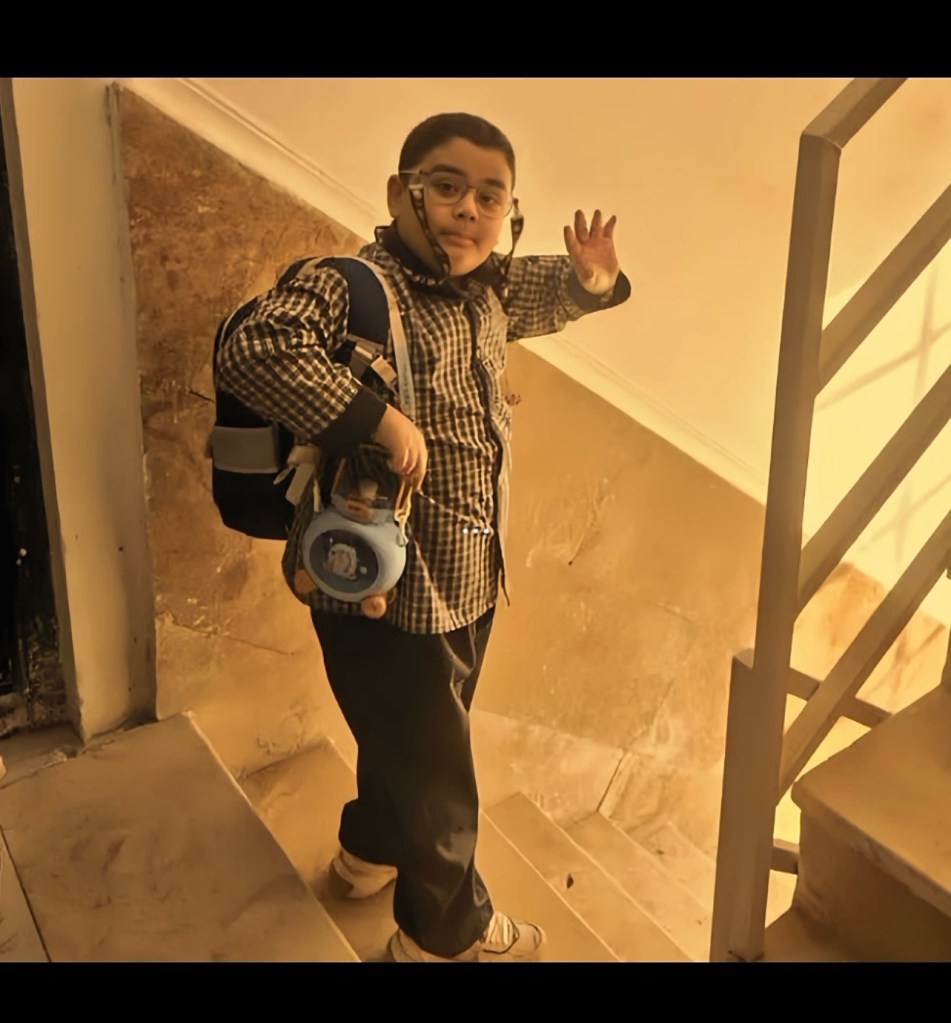
Here’s what I did this morning:
I read Heather Cox Richardson’s summary of the news while waiting for my 17yo to get ready for school. Listened to more news while dropping them off. Came home, settled onto the couch for a long, fortifying snuggle with the mastiff that serves as my homeopathic antidote to the news these days. She got into a septic field a week ago and her smell is finally just about back to its normal feral, calming musk. Went upstairs to change out of pajamas while scrolling through Instagram posts about the war: black clouds of oil raining over Tehran; a furious female lawmaker in Spain, decrying the notion that this war is for women when its first act was to kill little girls in their classroom; a one-year-old child being pulled from rubble of a building we’d bombed. And then: the photo above. A little boy waving from a stairwell. He’s chubby, with glasses fixed to his head by an oversized cord, wearing a backpack and a button-down shirt, carrying a silly-looking light blue something—maybe a lunch box, maybe shaped like an anime character—in one hand, the other raised to say goodbye. To his mother. As he left for school in Minab on Saturday morning. He was a third-grader, but now what they found of him is in one of those hundreds of holes carved out by backhoes in rows across the bleak gray field that maybe once grew flowers, but now holds the bodies of a school full of children. I looked at his photo for such a long time, imagining him with his mother at the store, picking out that lunchbox. I imagined her laying out his shirt and making sure he had his glasses, and then standing in the doorway taking his picture because look at him, oh my goodness look at him, and I dropped to the floor and I wept. For his mother, and for all the mothers in Iran, and Gaza, and Sudan, and everywhere, all of us, who love these children so much it makes us literally insane, who put cords on their glasses and treats in their lunches, and all around the world there are sick, selfish men who want to use their bodies for power, for gratification, for leverage, for revenge. I haven’t cried like that in a very long time, but it went on for a while, and then I went downstairs and started this post, but it started again later on, and when I returned to work on this some more, it started all over again. I have been crying about this child all day.
I’m not complaining. Mikaeil’s mother—if she survived the double-tap strike that killed the parents and first responders after it killed the children and their teachers—is laid out by a grief that we all say we can’t imagine, but we can. We do. We imagine it all the fucking time, and that is another thing they don’t tell you about before you become a mother. That the idea, the threat of that grief is a stalker who will follow one step behind you, every day for the rest of your life.
What I’m saying is, on the one hand: this is what it’s like to be an American with any remaining shred of empathy right now. You wake up, you’re reminded that we have become the cruelest bullies in the schoolyard, you grieve, you ask yourself what you can do. You learn things like how a double-tap strike works—and if you don’t know this, let me explain. It’s not just that we bomb something, and then we wait a little while and bomb it again. That’s atrocious, and depraved, but no. We sent a fleet of bombs over this area, and one struck the school, but another circled; it flew around, “gathering data,” watching what was happening on the ground. There were several sites targeted by this little fleet, but only one of them had people in it—the school. And so that last bomb that stayed aloft, observing, it saw the parents and the first responders who were rushing to rescue the children, and it marked them. There, some circuit inside it said, and down it went. We sent a bomb that hung around waiting, and didn’t drop until there were more people to kill.
This.
Is.
Who.
We.
Are.
But on the other hand: my God but it beats the alternative. No one is dropping bombs on my kids right now. The air that I breathe, by the time it circulates all the way to me from Tehran, will be much cleaner. Though we all live inside the same bubble. Those towering columns of petroleum smoke will come for us all, except maybe the shambling husk of our president, whose days on this planet are dwindling.
I feel like, everything that’s happening around us, I see it now: I see how it all fits together, the atrocities detailed in the Epstein files, they’re not just about sex and the carnal urges of powerful men—though that’s in there, certainly—they’re about networking, connecting, and making sure you can keep people on board by holding something over them. These men in power simultaneously demand that women keep doing their work, the work of reproducing, the work of making more little bodies for them to ravage and exploit, while poisoning the world those children are born into, using them for target practice, sending them to war. They wind us up about idiotic boogeymen—trans kids in sports, abortions in the water supply, DEI hires—to keep our eyes off the ball so that a small cadre of the worst imaginable men can amass more money despite already having more than they could spend in a hundred lifetimes. Meanwhile they send children to be raped as insurance policies; offerings for initiation into some sickening club, a blood brotherhood where innocent blood seals the oath. And then they stand on a stage, or they post on their platforms, that this is how we bring Jesus back again, that they are his messengers and his instruments, that this is what he meant when he talked about little children, suffering to come unto him.
I do think I get, now, know why that photo of Mikaeil has stirred such a specific horror for me (and, I suspect, many other American parents). It’s because we Gen X moms (and dads) have spent our parenting lives being regularly reminded that whatever goodbye you get when you drop them off in the morning might be the last goodbye you get. I have a thousand snapshots stored in my mind of each child climbing out of the car in the morning—bounding, slinking, stumbling, swearing—that I saved because there was always a voice in my head wondering aloud whether this was the dreaded day. Because I think I believed on some level that if I noted the possibility, it would pass me by. Like blood on the lintel. Like a prayer.
I don’t know what I can do about this. I don’t know what we can do about this. But I know that we cannot continue this way. Not us, as individual people, not us as a country. And I hope Pete Hegseth sees this child’s face every time he closes his eyes, until the day he dies.
 Make It Stop! (the sequel!)
Leave a comment