-
Paging Sarah Connor
The other night, I put on some Bob Dylan–a thing I have not done in many, many years–got to chopping garlic for dinner, and the next thing I knew, I was brainstorming a poem about humanity’s imminent annihilation by AI. As one does. Because in 2026, the crises are so numerous and fly so fast that the very idea of writing fiction or even essays about them is laughable, you really only have time for a poem before the next one blows up your phone. And because, I don’t know, maybe our phones noticed that we’ve stopped paying attention to climate change/Gaza/school shootings/measles outbreaks/Donald Trump doing (fill in the blank) and so it needed something new to scare us with this week? Which, I will say for myself, it really fucking did–enough to bring me out of hibernation here–with all these revelations about how the very people who are building the AI that’s swiftly making us stupider and more isolated while also killing our creativity are more than a little concerned it’s eventually going to kill us all. “Eventually” in this context meaning “in the next decade or so.” And when asked Why, then, do you continue to build it?, their best response seems to be Because if we don’t then someone else will and their version might kill us even worse. Or, Because none of us can trust that the others will stop so we can’t, either. Or, Because when the machines inevitably take over, we want them to know we were on their side. The most brilliant minds on the planet, and this is the best they can come up with: we can’t stop building the thing that will destroy us because we at least want to know that whatever version of it ultimately seizes the reins of this beautiful globe and shakes humanity off like the infesting fleas we are will be our version. A handful of friendless losers with God complexes and endless money, building a thing they call “Superintelligence” to show the world how brilliant they are, accidentally (or not) ruining the world. If that’s not the logical end result of patriarchy and late-stage capitalism, I don’t know what is.
Seriously, though: have none of these tech bros watched Silicon Valley?! War Games? The Terminator movies? Fucking 2001???
I will stipulate, though, that maybe it really is superintelligent if its plan is to wipe out humanity. And that it might not actually be the AI that’s making us stupider, as it appears we have, as a race, been pretty colossally fucking stupid all along.
I don’t know about the rest of you, but I have become deeply and furiously tired of living with a gun to my head. Maybe we each have our own fixations, our own personal vulnerabilities when it comes to which threats we respond to, but for me, climate change has been an ever-present background terror for as long as I can remember, though the threat level ratcheted up dramatically once I became a mother (a fun fact people allude to but that you can never really appreciate until you have an actual child of your own in the world). But it’s widely understood that people can get used to anything, and I realized this week that I’d gotten used to the idea of climate catastrophe the way a person might get used to having a chronic illness, which is to say that it’s something I’d learned to live with: unhappily, with great emotional discomfort, but its ultimate outcome seemed far in the distance, and not totally clear. Like, maybe things would stay livable throughout the remainder of my stay, and possibly my kids would be more secure than most. That was the place of mental compromise I occupied most of the time, save for when the occasional heat dome or wildfire sent my cortisol skyrocketing. I was able, with some effort (mostly between the wakeful hours of 3 and 5 a.m.), to continue living the life I wanted to live.
But this AI thing? Feels like a terminal diagnosis. It feels like You have one to three years left. And by you, I mean all of you. On the planet.
Standing at my kitchen counter the other night, feeling the panic rise in my chest as I pondered this week’s unbearable news (as distinct from every previous week’s unbearable news), I felt myself going a little wobbly. It happens every now and then, when the overlords or whoever it is running this show decide to step up the planetary threat level by announcing that we’ve run out of ice in the Arctic or there are no more whales or, I don’t know, the Trump administration has a new policy to give free AR-15s to everyone who votes Republican–there’s a part of me that just has to ask itself, Can I keep doing this? Like, how am I supposed to handle this? It’s not about wanting to give up, it’s more a question of whether I have the capacity. How much is any one human being supposed to handle? Historically, the thing that has provided me the most consistent comfort–in the wee hours while I lay sleepless, grieving the myriad glorious creatures, landscapes, lifestyles vanishing from the face of the blighted earth, or when my heart pounds and my palms sweat at the thought of the wars, famine, societal collapse I or my children might live through–is this: that no matter what else has been ruined or lost, one thing has not and will never change, and that is the fact that we were all going to die, anyway. That was always going to be the end result, so that, at least, is still true. At least there’s something we as a species haven’t managed to ruin! It is the bleakest of all possible consolations, I know. But it’s been working for me a long time now.
So, prepping our dinner with Don’t Think Twice (It’s Alright) playing for the third time, I fell back on my usual coping mechanisms: I thought about the native Americans, who lived through an apocalypse and still remain. The African people who survived through Middle Passage only to endure a centuries-long odyssey that surely felt unsurvivable much of the time. I thought about the people in Gaza, who live every single day with the prospect of annihilation by both sentient humans and some of the most sinister AI on the planet, but continue making movie theaters out of the rubble for their children, and writing poems and cooking for one another and building whatever lives they can. And I thought about the many people I’ve loved in the course of my life who were here one day and gone the next, because nothing in this life is guaranteed except this: that every one of us, no matter how beloved or reviled, will eventually draw their final breath.
I’m looking at you, Elon. Altman. Thiel. All you fucks. Build what you will, revel in your God delusions. You’re still going to end up just as dead as the rest of us.
There are a couple of ways you can go with a strategy like mine, of course. One is fun and carefree: Life is short! Eat the pizza, drink the tequila, go home with whoever you want! And I do try to embody a certain amount of that philosophy. But it’s easy to let oneself get dragged down into futility: Why bother working on this revision? The world will be over before I get this fucker published. Think too hard about all there is to grieve and the sadness is a quicksand that will never let you go. I know several of my family members would urge me to consider the life to come, and I would have to tell them to stop right there because talk of the Lord is a hard pass for me. If an afterlife exists, I have no fear of it, because there is not a cell in my body that believes in the punitive, score-keeping God of the Bible who would consign His own flawed, fragile children to an eternity of torment. What I do believe is that religions–and Christianity most of all–have relied on promises of eternal reward in the afterlife to justify and rationalize incomprehensible abuse and exploitation in this life, and bear enormous responsibility for the plight in which we find ourselves today. So no–miss me with your admonitions to take comfort in the knowledge that heaven awaits.
Mostly I try to aim for the sweet spot between thoughtless hedonism and bleak despair, which is something along the lines of running down the street in broad daylight screaming WHAT ARE WE DOING, PEOPLE? WHAT ARE WE DOING?
WHAT?
ARE?
WE DOING???
The problem is that, for myself at least, most of the screaming happens inside the echo chamber of the internet and so…not super effective. There are other tactics, too: community building, creative expression, the determination to continue living one’s life despite the overlords’ (and the devices’) determination to keep us distracted and terrorized. Why should I trust that all this is, as one of the “whistleblowers” claimed, “not a marketing stunt?” These people have not demonstrated themselves to be trustworthy, and if Gen X has learned anything by this stage of (mid)life, it’s that America runs on Americans being afraid of something. You can pick your poison but whatever you choose, it’s all the same in the end.
If you read this far hoping for a conclusion of some sort, or an action step or a deliverable, I’m afraid I have to disappoint you. I don’t know what we’re supposed to do about this situation–vote? protest? take to the streets? unplug from all our devices and start learning to live off the land? I just know that what we are doing, right now, is entirely insufficient.
We should all be screaming all the time.
-
Full Moon Tuesday
A few months ago, it was brought to my attention that my blog had achieved a somewhat wider readership than I’d previously realized. While it’s true that the entire point of this new site is to assist in getting my work before a larger audience, this still came as a bit of an unpleasant surprise–these were not the readers I had in mind! And I had some questions…some feelings….about which of my followers might have contributed to this unexpected expansion of my audience. So I went quiet here for a little while, pondering how best to proceed. But I’ve taken it in now and decided I’m on board: the more, the merrier! It’s such an old habit, going silent for fear of other people’s reactions, and the whole point here is to do the opposite of that, to embrace the “no fucks left to give” spirit of this stage of life and just say whatever is in me to say. And it’s not only the habit of shrinkage that’s kept me from posting here: there has, in fact, been quite a lot going on. I’ve been working on multiple writing projects, and I went to Tunisia, and my oldest child returned from living abroad in time to see my youngest child graduate from high school, which has meant lots more time with my children in general and my daughter in particular. My garden is going gangbusters, I have chickens now…I am busy all the time, but for the moment, alhamdulillah, it is all the best kind of busy-ness.
And, since we’re on the subject, I’ll just throw out a few recent bits of good news. The other night I was telling my Muralist friend about the weirdly misspelled and ambivalent email I got from an agent who has expressed considerable enthusiasm for my novel manuscript. I told him that it left me confused and discouraged because on the one hand, she quoted me back to myself and gushed about how much she loved what she’s read so far, but on the hand, it’s taking her forever to finish, and she made a comment about this not being precisely the genre she knows best, which is definitely not what the bio on her website says and feels like the beginnings of a rejection. He reminded me that in cases like these, the truth is often much more quotidian (and less personal) than we imagine: “Maybe she’s getting a divorce right now. Maybe she’s taking care of her sick mom. Maybe one of her kids is on drugs. Who knows? It probably has nothing to do with your book.” I told him I’d responded by mustering all my self-confidence. Keep reading, I emailed her back; I promise you, it has everything you are looking for. Everyone who’s read it has told friends about it. You will not be disappointed; the final third is a wild ride. He loved hearing this, which I knew he would because he’s the person who’s been teaching me how to take my own work seriously and be my own best representative for years now. “As artists, we have to hype ourselves up. We have to promote our own work. You did the best thing you could do in that situation, which was to tell her, Lady, look: you will be lucky to represent me.“
And so, in that spirit, I’ll note that in addition to this agent, I heard from another recently who also requested the full manuscript. I have a short story appearing in the current issue of a literary journal that probably a hundred people will see, but it’s another credit I can put in my query letters. I have a memoir piece coming out on Substack next week, and I am very near finishing a short story I’ve been working on for a while now about two friends driving cross-country to get one of them an abortion. And, as you might’ve seen last week, I wrote another poem. Which is of course not the genre I know best, but it feels good sometimes to knock something out like that and feel like I captured–what was the definition they gave us back in high school? A poem is a moment of intense emotion, recalled in a period of clarity? Something like that. Every fucking day is intense emotion in this timeline. The periods of clarity are few and far between. Maybe when the next one comes around, I’ll go back and revise. And maybe the more I focus on my recent wins, the more I will have to look forward to.
Happy Jupiter cazimi and Full Moon in Aquarius, folks! Here’s to all of us who are trying to put ourselves out into the world in new and terrifying ways.
-
Breaking The News
When I told my then-five-and-a-half-year-old daughter that her grandmother had died, she laughed at me. “No she didn’t!” she exclaimed, scandalized by my lie, and then scampered off to finish her movie in the living room. I remember feeling completely unmoored: by the shock of my mother-in-law’s sudden, wholly unexpected death, by my grief and my husband’s, probably by the ocean of pregnancy hormones in which I was, at 32 weeks, awash, and most of all in that moment by my complete and total ignorance of how to handle this situation. I thought that I had to make my daughter understand, right now, in real time, that her grandma was gone: it felt urgent, immediate, even though of course, the thing had happened, we had the rest of our lives to live with it. It was just such an overwhelming experience, the first time I’d lost someone that important to me, so of course I had no idea what I was doing. But as anyone who’s ever guided a small child through grief knows, there’s breaking the news, and then there’s helping them understand. The first thing, you do once. The second thing, you do until.
I’ve been thinking a lot about that experience since ICE murdered another innocent person trying to live his life and provide for his family. In every one of these horrible stories of parents torn from their children or people gunned down in the street, there is some gut-wrenching detail that stands out to me, something I can’t let go of. What I keep coming back to in this case is the video of this young man’s partner talking about what a wonderful father he was, how besotted he was with his little girl. I listen to her speak, and all I can think about is the grueling process that lies ahead for her, not just of grieving her own loss, but of helping a three-year-old through hers. You cannot imagine, if you’ve never done it, how impossibly difficult it is to answer your child’s questions about why the person they love can’t come back: how exhausting, how frustrating, how much it can make you want to stop the car or walk out of the room or hide underneath your covers, just so you don’t have to say the words one more time. Just so you don’t have to keep seeing their faces, hearing the pain in their voices, as you break their hearts for the thousandth time with this relentless, unalterable reality. It feels like it goes on forever, and that is what lies ahead for this young mother who has lost so much. This is her work now: another kind of mothering for which nothing can prepare you.
For Karolina
You might think that the moment when
a pajamaed girl with a pink backpack sees
her world explode in a cacophonous spray of (blood)
bullets and a rain of shattered (bone)
glass would be enough to make that girl understand
that the father she loves is gone.
But you would be wrong.
The work of teaching a child that death is forever
is grueling, and difficult, and tedious.
It is labor
that you must perform every day, over and over again,
finding answers to the same innocent,
impossible
questions of Where? and When? and Why?
even when your body feels as lifeless as his was, lying in that street,
and your throat wants to close around the syllables like teargas.
And maybe it was some
jacked-up wife-beating PTSD motherfucker
who shot your beloved on a Monday
morning on his way to work,
but it is you who will have to explain it to his Gordita,
over and over again, every day, trying to make sense of the senseless:
with empty excuses like gone, and forever, and I don’t know.
It is your words that will fall like hammers, breaking
the tiny bones of her small fingers,
doing the work of deconstruction that razes
“before” to make space for “after.”
And it makes you a kind of accomplice
in her father’s murder:
not the one who pulled the trigger,
but the one who refuses to bring him back,
the one who keeps telling her never, and always,
the one who keeps saying it—
dead he is dead he cannot come back he can never come back—
despite her tears
and her pleas. All that labor
just to build something nobody
anywhere
wants.
The chamber of the heart that can contain immeasurable loss
does not develop on its own, like an eyelash
or a hand.
It requires an absence to form around.
Then it permineralizes, slowly;
accretes over time
like a fossil.
This is what you’ll mean when you tell her
Your papa will always be in your heart:
that he will be the stone at her center,
and the emptiness inside it
will be shaped
like him.
-
What Might Have Been
Several months ago, a box arrived at my house. It came from the storage loft in the house my ex and I used to share; they’ve been renovating over there, and he came across this box and asked me if I wanted it. I said sure, and then, when it arrived, immediately froze at the prospect of going through it, so I put it on the floor of my office and that’s where it stayed, patiently waiting all this time. This is notable, if you know how much I dislike clutter in my workspace. A couple of weeks ago, I started thinking about a piece I wrote long, long ago about the house my dad lived in throughout my childhood—the house my mother and I left when their marriage broke up. The climactic scene of that piece depicted a night some time after my dad married my stepmother, when she informed me in no uncertain terms that the house no longer belonged to me, that it was hers now and I should never forget that. That night—that speech—was emblematic of the way I felt my stepmother replaced me in my father’s life, and I wanted to rework the piece from my perspective now, so I went looking for it. When I couldn’t find it in any of the digital files of my writing, it occurred to me: it’s probably in that box. So at long last, I sat down and started digging through it. What I found…surprised me.
The piece I was looking for was right there, as I’d expected. The box is packed with manuscripts I wrote while I was in graduate school, and before that, while I was taking classes at Cleveland State in preparation for applying to grad school. There are academic papers, creative nonfiction, excerpts from what would ultimately become Dark Matter, and short stories: so many stories. The first thing that stunned me was the volume of my work: did I actually write all this? How had I forgotten any of these stories existed? The second thing was the critiques penned on final pages and throughout the margins by my classmates, teachers, and writer’s group partners. This is the most accomplished manuscript I received this year, wrote my beloved CSU professor, Sheila Schwartz (a brilliant writer whose work few people know due to her untimely death from ovarian cancer). My graduate adviser scrawled uncharacteristically effusive praise on a revision of a Dark Matter excerpt, which reminded me that he’d held it up as an example to the class of what good revision looked like. Not everyone loved everything I wrote, obviously, but the gist was clear: this work is strong, original, interesting, funny. It’s really good. Keep doing it.
Amidst all the short essays about my crazy family and aspirationally Kafkaesque stories about homeless squatters taking over people’s houses and yoga students uncovering long-lost memories, was a story inspired by the little girl who lived nextdoor to my ex and me while we were in grad school. It’s about an ugly little redneck girl who falls in love with the host of her favorite Jerry-Springer-style TV talk show and then realizes, after she hears her dead mother speak to her through the family answering machine one night, that the story could get her on his show. It is a quintessentially 1990s story that beautifully sends up a particular cultural craze and lets an unlovable heroine triumph. I reread the entire thing on the spot, sitting on the floor of my office, and I loved it as much in that moment as I had while I was writing it.
Why am I dragging you on this long trudge down memory lane? Because it brought me to a surprising and painful realization: all of these manuscripts were written between 25 and 30 years ago. That’s half my lifetime. And they’ve been sitting in this box ever since.
Maybe that’s not a hundred percent true. I never let go of Dark Matter; it went through multiple iterations, but it ultimately became the novel it is today, something unique and beautiful that I would be proud to let stand as the sole literary accomplishment of my lifetime, if anyone would let me (though it won’t be! Because I’ve published multiple short stories already and have another coming out this spring! I’m saying this to me, not to you!). But the rest of it? The thousands of pages of writing about motherhood, friendship, politics, womanhood, family dysfunction, history, memory, hope? What has become of any of it? What ever will become of it? There are a lot of reasons I haven’t achieved the kind of career success that, in my mind, would show I have “done something” with my talents: introversion; the total absence of any understanding of the “business side” of creative work; the lack of a literary network and the connections that would provide; a belief that my work was not as important as my husband’s, and was therefore reasonably pushed aside in support of his; a desire to stay home with my kids and be their primary caregiver. But the biggest obstacle, if I’m honest with myself, was my own fear, and my biggest fear was of how the people I loved the most would feel about my work.
My Muralist friend recently made a discovery about himself that has triggered a wave of reflection and regret. What would be different about my life, my family, my career now, he wondered aloud, if I had figured this out twenty years ago? He has the kind of career I imagine would feel like success to me: he supports himself and his family with his work, he is out there every day making his art and getting recognized for it—and yet, he feels so much frustration because it is still such a daily struggle to stay afloat, he hardly has space in his life for anything else. No sooner had we talked about his grief over what might have been than I sat down beside the box, and was suddenly confronted with the same overarching question. What would be different about my career trajectory, if all my decisions hadn’t been grounded in fear? What would be different about my life, and my family? Are these simply the sorts of questions everyone asks when they reach a certain point in life? I thought I’d already been down this road in my forties—and I believed I’d be farther along by now. The grief that wells from some deep unacknowledged place when I ask myself those questions about my work is suffocating, but I know that the consequences of not acknowledging it are, perhaps, even worse.
The choices I made were mine alone; I don’t blame anyone else for them. Others absolutely benefited from them, even relied upon them, but it was I who opted to keep myself small, and silent, out of a multiplicity of fears: that people I loved would be angry about (or hurt by) what I wrote; that eventually I’d be outed as a hack and a fraud; that I would fail; that I would succeed. And always, underneath all of those, the eternal fear that it’s already too late for me to be the writer I’ve dreamed of becoming. This is the binary system I’ve existed within my whole life: the supersonic engine of need to be doing the work I was put here to do, and sending it out into the world, and the paralyzing, existential terror of being seen, and found inadequate. Or wrong. Or selfish. Maybe it’s not such an unusual dilemma; maybe other people just navigate it earlier in their lives. Or, possibly, never at all, though that last one feels like not an option. Maybe it’s the discomfort of having an additional binary added into the gravitational system: the…what? Acceptance? Grief? Integration? of what is no longer possible, balanced against the possibilities that still exist. And the recognition that time continues to pass, regardless of what any of us do, or don’t.
-
Spring, 2026
A few weeks ago, as you know, I went to Tucson for a writers’ workshop. I’d been invited because of an essay I’d submitted to a contest—an account of how I made peace with the English Bulldog who became mine after my divorce—and so, when we finalists were divided into groups, I was assigned to the nonfiction category. I could’ve opted for fiction instead, since that’s primarily what I write, but I decided to stay where I’d been put and submitted a manuscript of pieces I’d written about my divorce. If you’ve been reading me for a while, you’ve probably seen them; three of them originated as posts on my last blog. These pieces are intensely personal, and reveal a great deal about my marriage and how it ended. One of them, in particular, is so searing that I cannot imagine how I would ever publish it—my ex-husband would surely lose his mind. But I wasn’t submitting these pieces for publication, I was just sharing them with a group of fellow writers, getting feedback on the work.
The more times I read them, though, the more strongly I felt about the work I’d submitted—that it’s good. Some of my best, even. That other people would want to read it. Also, on some level, I was asking myself: are you seriously sharing these pieces for workshopping when you have zero intention of sending them out? I tried not to think too hard about that question. I focused on basking in the praise that flowed from my fellow writers.
After I got home from Arizona, I had a flurry of obligations and some catching up to do, and I didn’t do much writing, but then a week or so ago, reviewing the comments on my manuscript, I decided to return to Maggie Smith’s phenomenal memoir of divorce (and also of trying to be a writer and a mother at the same time), You Could Make This Place Beautiful. The first time I listened to that book, I’d churned out the three blog posts that became the bulk of my workshop submission; I remember walking the bike trail near my house, listening to the audio on my earbuds, pausing it every two minutes so I could dictate a note into my phone. I have never had a book affect me like that one did, every other sentence, seemingly, triggering some memory or association or revelation or idea. So I started it again, and it’s been just like last time. I have a list in my Notes app nearly eight screens long of ideas from my own marriage to write about that came up while I listened to Maggie’s book. I’ve written first drafts of five new pieces, and started several more. That familiar joyous obsession—the persistent itch to get back to work because there are so many more things to write about—has been with me ever since I started listening, nearly two weeks now.
One night, I went out for a walk in the evening after dinner. I was listening to YCMTPB, and then I paused it to think about some of the things that were coming up for me. I’d made a few more notes in my phone of ideas sparked by her story, and suddenly, as I climbed the steps that connect my neighborhood to the park behind my house, the voice in my head spoke directly to me. You realize you’re writing a book, right? I’ve been writing a book my whole life. I was writing one book for 20+ years; then I finished it, and I started another, but what came to me the other night was, that’s not the book I’m writing now. I’m not writing another novel; I’m writing a memoir. Oh my God, I replied. And then…I can’t think about that now. I just need to keep writing.
Last Wednesday, I had a session with a medium. I’d wanted to meet with him while I was in Sedona, after Tucson, since that’s the sort of thing people like to do in Sedona, but he wasn’t available then so I booked a zoom session and did it from my bedroom. There were things I wanted to hear, and I did hear them, though I’m not convinced they came from where he said they did, but at one point, he asked me, “Are you writing a book?” I laughed, and I said yes, and he told me both of my parents were urging me to keep writing it. He said that the world needed my voice, and I should finish my book and get it out there because other people will benefit from my story. I thought about saying, “Yes, but do my parents understand that the fucking world will end if I write this story and my ex finds out about it? Do they know what that will mean for me?” No one in the afterlife, it seems, is concerned about it.
Last night, I had a dream. My dreams have been off the hook for weeks, wild and ridiculous and vivid and numerous; several have included my ex, and various other men in my life. Last night, though, there was none of that. I dreamt I was crossing a kind of bridge. The details are hazy; I seemed to be on a hike, through a desert-looking landscape, and I wasn’t alone but I don’t remember who was with me. There was a weird formation in front of me, what looked like a huge white boulder wedged between two rocks, but when I stepped on it to cross, it collapsed, and I realized what had looked like a boulder was actually a gigantic hornets’ nest. It fell to the ground and split open; a wave of terror washed through me as I imagined the wasps about to swarm out and sting me, and I turned to run, but whoever I was with wasn’t worried about it. They waited, and so I hesitated, and a moment later the wasps did pour out in a buzzing cloud, but they didn’t swarm me. They didn’t even care about me; they made a lot of noise and then zoomed off in every direction, all around us, driven by whatever alien drives power wasps. Within seconds, they were gone.
The hornets’ nest was empty. I was fine.
I may need you to remind me later.
-
Civilization
So. How’s your day going so far?
Today is April 7th; it’s the first Tuesday of the month, my favorite aunt’s birthday, the date of the sun’s annual exaltation. Also the date on which our lunatic president announced that “an entire civilization will die tonight,” not that he wants it to, but sometimes things are out of his hands. Except when he wants to take credit for them, whether he deserves it or not. Which he very much does in this instance, since this entire war was his idea and his doing, the conditions that now precipitate his threat did not exist before he started the bombing of Iran, and if in fact we–the collective we, not that any of us are involved–do in fact bomb Iran back to the Stone Age, it will be because he decided it was the only way to get us out of the global fucking disaster he has gleefully gotten us into.
{Siiiiiiiiiiiiiiiiiiiiiiiigh.}
I want to say something meaningful here, not because my blog post is going to alter the course of whatever future we’re careening toward, but because I just want to know that I went on the record as saying that I viscerally and with great fervor do *not* support whatever it is he has in store for Iran tonight. Which, very possibly, is nothing, since we know that he is a liar and a chicken shit and also a manipulator of markets and says whatever he thinks will make him look powerful and make him money. It could be that he lets Israel blow up all Iran’s railroads and then announces our work here is finished and we’re going home. I don’t know, and I don’t know what to say about it, all I really know for sure is that this would be a really great time for the universe to send one last little blood clot hurtling through a certain maniac’s most congested coronary artery.
I have a lot of feelings about how we got here, as, I imagine, do you; most of mine revolve around my deep and ever-growing rage at organized religion, the ways in which it seems to poison and pervert so much more than it inspires. I have struggled this whole long year and change since the last inauguration with my feelings about certain family members who voted (AGAIN!) for this madness. That the same people who never missed a single opportunity to proselytize at me throughout my childhood have somehow either forgotten or outright rejected every single teaching of the man they insisted I invite into my heart is infuriating, and depressing, though perhaps it also validates my refusal. Look how much good it did them! But also, there is a fetishizing of apocalypse that runs through certain strains of Christianity (though it’s hardly exclusive to the Christians), and that bloodlust for the end times is on full display right now with Hegseth and Trump and Vance all salivating over nuking Iran. When the greatest thing you have to look forward to in your belief system hinges on the end of the world, there’s not a lot of motivation to keep that world in good working order. I am angry today, more so than usual, at every single person who got us here: every person who voted for this guy, or didn’t vote, or voted for some third-party idiot who never stood a chance. I am angry at every person who said “I don’t like either one of them,” then voted for a blasphemer and a pedophile over a competent woman who never raped anyone. I am angry at every person who claimed they were voting for the “lesser of two evils,” and then chose absolute evil.
I don’t know what will happen tonight, or tomorrow night, or next week, but I know this: we cannot continue to call ourselves a civilized nation if we allow this to continue. “Civilization” is defined as “the stage of human social and cultural development that is considered most advanced.” If we leave this monster in office, and sit idly by while he boasts of his plans to murder a nation of 90 million–whether or not he actually attempts to–then we no longer meet that standard. The president might very well be correct when he says a civilization will die tonight. It may not be the one he thinks.
-
Notes From the Road
Yesterday I left town for a week in Tucson and Sedona, to attend a writer’s conference and then bask with a girlfriend in the woo-woo energy of the northern Arizona energy vortex. I was a little nervous heading to the airport, as my instagram feed is currently 30% capybaras, 50% end of the world, and 20% TSA security checkpoint horror stories (lines out to the parking garage in New Orleans! Three hour waits in Houston!). I knew I was flying out a dinky little airport that’s probably only “international” because it has a flight to Toronto or some such, but I was still a little nervous about missing my flight. I needn’t have worried; there was exactly one person ahead of me in line.
Since I was quite early, I staked out a good spot where I could spread out and make myself comfortable reading the last few manuscripts I needed to review for this conference. I was annoyed when, soon after, some random man came and sat in the middle of my workspace. I defaulted straight to judgment mode and clocked his shaved head, ostentatious scraggly white beard, and conspicuous tattoos (though, to be fair, not the prison variety)…was he MAGA? White nationalist? Something told me no, but I stayed on alert. For the next hour he hunched over his phone, watching something on YouTube, I presume, then suddenly erupted in outrage. “Goddamnit!” he exclaimed, “Are you fucking kidding me?” A cloud of nervous glances gathered around him, and I threw all my energy into maintaining the impermeable shield of invisibility all women learn to manifest around the time they hit puberty. Yes, it’s awkward to pretend you don’t hear someone who’s shouting profanity at their phone two feet away from you, but you’ll never survive in this world if you can’t. As the nearest person to him, I knew I was vulnerable to being dragged into whatever drama was unfolding in his plans/life/imagination; I began to debate vacating the scene.
“The curse of BWI strikes again!” he announced to no one in particular, and part of me felt a little sad; I know that urge to have the world share in your dismay. But then he shouted, “Jesus Christ, is there anything Trump can’t fuck up?!” and I laughed aloud involuntarily. Turns out he had a text saying the extraordinary security backlog at BWI was impacting departure times, and his next flight had been delayed several hours.
“No, and don’t tempt him,” I responded. After that, we were friends.
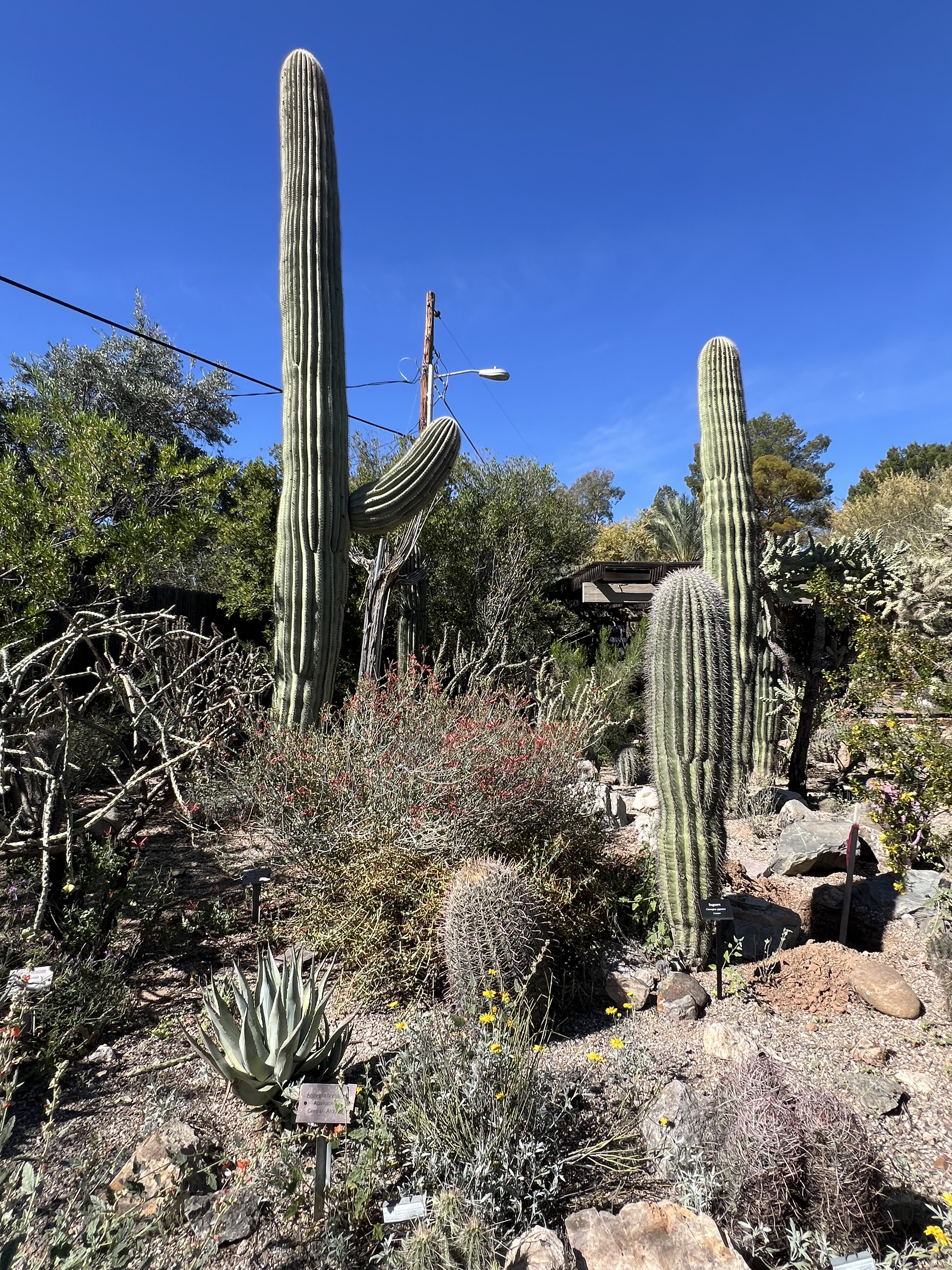
My travel was mostly uneventful. The first flight contained at least 50 Michigan middle schoolers returning home from a field trip to (I assume) Colonial Williamsburg, as well as the most ferociously outraged baby I have ever heard. Both the smell and the noise level of that flight were unbearable. Every child aboard had at least one soda, one bag of Sour Patch Kids, and one bag of Takis, so I can only imagine the atrocities inflicted upon the lavatories. My second flight, full of adults and departing at 9:30 pm, was dark and silent. I arrived around midnight local time and got a cab to my AirBnB; along the way, I exclaimed over the saguaro cacti I saw everywhere along the road. “They have to be at least 50-75 years old before they even start to get a arm,” my driver told me. Somehow, the fact that he said it this way–“A arm”–made it sound even more remarkable–mysterious, foreboding. But maybe that’s just because it was 3 am for me. “The ones you see that are 30 feet high, with arms going in every direction? Those ones are like 150 years old.”
“Holy shit,” I said, as understanding dawned in my brain. “They’re like trees, but different.” Which, I know, is exactly the sort of penetrating insight that brings you to this blog.
“And they’re protected,” he added. “So you can get in a lot of trouble if you steal one.”
This, I’ll admit, took me by surprise. “Steal them?” I asked. “Steal the cactuses?”
“Yeah,” he said, “I guess you need special equipment or something ’cause they got all those spines, but you can do it.”
I thought of the prickly pear cuttings a friend had gifted me, how you just set them in the dirt and they start to grow, no potting necessary. “Because they don’t really have a root system!” I said. Mind blown.
“Exactly. The baby ones especially, you can just pick them up and drive away with them.”
My mood darkened abruptly as I considered the trauma of baby cacti, kidnapped in the middle of the night.
He had a lot of recommendations for things to do, though, including my first stop this morning, the Tucson Botanical Garden. This was a lovely way to start my visit, and I took a lot of photos that document not only the astounding variety of surreal and scary-looking flora here in the Sonoran desert, but also the reality that when I am wearing sunglasses, I cannot see my phone screen at all. Basically I’m just pointing my phone in the direction of whatever I’d like to remember and hoping for the best, only to find, when I get home, a collection of blurry, off center tree limbs and bird butts, plus accidental shots of my own face, scowling.
After the garden, I called a Lyft to take me to 5 Points Market for lunch, and was alerted by the app that my driver would be deaf or hard of hearing, so I should use text if I needed to communicate with her. I immediately went on YouTube to refresh my memory of how to say “thank you” in ASL, imagining that single gesture would be the extent of our communication; the driver who’d brought me to the garden in the first place had said my name when I got in the car and then never made another sound. I gave him 5 stars. This new driver, Ellen, pulled up to the curb and started peppering me with questions the moment I opened the door. I uttered six words–“I’ve never been to Tucson before!”–and she was off to the races with recommendations. Aren’t you supposed to be deaf? I almost said, but I hardly had the chance to interject; she told me about all the high end resorts up in the mountains that surround the city (though obviously I already have a place to stay), then moved on to food recs, which I definitely was interested in. Hers were singularly awful. She pointed out one chain restaurant after another as we cruised past a slew of strip malls and shopping centers–Asian, Italian, a place called “Cheddars,” a pizzeria–and when I said, “I’m in Arizona, I want to eat Mexican food!”, she said the Mexican here is too spicy (turns out, she’s from Chicago). But she urged me repeatedly to go to Forbes Meat Market, and she loves the French fries at Applebee’s.
I told her where my Airbnb was located. “You could go to the Holocaust Museum,” she offered.
I don’t mean to suggest she wasn’t a good conversationalist. When I told her my conference is meeting at the Marriott by the University of Arizona, she piped up “That’s right by where all those kids were killed!”
“Oh!” I exclaimed. “Um, what kids?”
Apparently some billionaire’s asshole son crashed his car into three college students crossing the street and then kept driving. “You can google it, the kid got out on a quarter million dollars cash bail. I think he should lose his license,” she said, “and make restitution. And do community service–you know, give something back.” I started to say I was impressed that she didn’t want to see him thrown in jail, but she cut me off. “And he should definitely spend time in prison. A lot of time.”
Since we were on the subject of crime, I asked her, “What do you think happened to Nancy Guthrie?”
“Epstein files,” she said. I agreed they’ll never find her.
Ellen dropped me off at the 5 Points Market, where I’d been told to get the huevos rancheros. “That’s the Forbes Meat Market, across the street,” she said for the third time. I gave her 5 stars, too.
-
Find Your Why
We have now entered Fund-A-Thon season in abortion world, the magical 11-week period during which abortion funds all over the country try everything they can think of to get people to donate so we can keep doing what we love to do—fund abortions! In our recent board call to brainstorm ideas for fun ways to get money, we were encouraged to “find our why”—figure out the reason(s) we care so much about the work we do, so we can communicate that passion to our would-be donors and, hopefully, inspire them to give. Meditating on my own why got me thinking about my mom, and how she helped shaped my views.
My mom loved to say that she never left the house during the 60s. Specifically, she meant the last part: the civil unrest and the Summer of Love and her oldest brother fighting in Vietnam while her youngest ones were trying to grow weed in the back yard of their house in northeast Ohio (with minimal success). She hated everything about that time—the music, the fashion, the chaos, the relentless machine of war that took so many of the boys she went to high school with and never gave them back. She would’ve been 26 in 1969, working as a legal secretary in downtown Cleveland, soon to meet the (married) man who would become my father, and she was not the sort of person who was ever going to hold a sign at a protest or stick a flower in the barrel of a gun. The very idea gave her vertigo.
This is almost certainly what drew me to activism.
My protesting career got off to a bumpy start, owing to the fact that I was on the wrong side of the issue in question. I’d gone with my best friend and her mother to the 1980s version of what we know today as the March for Life—a rally on Cleveland’s Public Square commemorating all the murdered babies whose unbaptized souls were, in those days, still presumably consigned to a sad eternity in limbo (I believe it was Pope John Paul II who released them a few years later with his decree that, unlike dogs, all fetuses go to heaven). Up to that point, I’d had no opinion on abortion whatsoever; I only went because my best friend was going, and she only went because her mother was making her. I don’t remember much about the experience other than being clustered for warmth around the Soldiers’ and Sailors’ Monument while the frigid January wind blew in from the lake, and being handed a microphone and a “poem,” which I was asked to read for the assembled crowd. All I retained from that bit of literature was its format—it was typed in the shape of a fetus in profile—and its all-caps final line, TODAY MY MOTHER KILLED ME. I recently googled it and discovered there are numerous versions of this slop on the internet—you can look for yourself if you’re curious, I’m not linking to it—and while it is appalling from a literary perspective, it is somewhat instructive as a piece of propaganda. Its title is—unsurprisingly—Diary of an Unborn Child (spoiler alert, she would’ve been a blonde, blue-eyed girl with a weird fixation on hair), and its goal is, obviously, to humanize the unborn child while shaming the woman who doesn’t want to be its mother. Forty years later, the anti-abortion movement has updated its technology, if not its approach, by creating an AI-generated”Baby Olivia” video which uses a baldly manipulated developmental timeline to tug at viewers’ heartstrings and mislead them about abortion. Legislators in several states (including my home state of Ohio) are working to make the video mandatory viewing in public schools. If you’re reading this in Ohio, make sure to vote no on that measure in November.
Thankfully, my indoctrination was thwarted the minute I got home by my mother, who surely had a few choice (read: profane) words for my best friend’s mother when she found out where I’d been. I can still picture the scene: she sat me down in one of the bouncy Breuer cesca cane chairs of our little kitchen with its six-inch black-and-white TV on the table and its orange-and-gold foil wallpaper (my bedroom was papered in grasscloth; the entire condo, an atrocity of 1970s interior design) to explain why, in our family, we support a woman’s right to choose. She told me the story of my most beloved family member, who’d been carjacked at knifepoint years before, and sought an abortion when she found herself pregnant afterward. She told me about other family members who’d had, or paid for, abortions because their lives would have been upended by a pregnancy or a child. This may have been the point at which I began to realize that, though she was sending me to Catholic school, she didn’t actually have a lot of patience with Catholicism. It wasn’t until a few years later that I learned of all the bullshit she’d had to put up with from our pastor, Father Viall (yes, that’s his real name, and he really was), for being divorced, and for having had me baptized in (horrors!) my father’s Presbyterian church.
Interesting side note: years later, I learned that the kidnapping and assault were not actually what led my relative to seek an abortion. She had it because she already had multiple children, closely spaced, with an abusive husband she couldn’t leave, and another child was more than she could bear. This detail speaks to the truth that a lot of people support the right to seek an abortion if the reason is good enough. My mom seemed to believe that becoming pregnant after a rape was a good enough reason, but simply feeling like an additional child might break you was not. The more I learn about abortion, the more I see this perspective in our public conversations about it, and even in my own attitudes: abortion should be “safe, legal, and rare,” as Bill Clinton loved to say. That abortion should be a last resort, a thing you do once because you’re desperate, but only when you’re really, really desperate, and never more than once is a perspective many of us have adopted in this country, even though it’s not based in history or reality. It’s a perspective we need to let go of, because this is how extremist lawmakers end up passing abortion bans that claim to allow “exceptions” for the good enough reasons—rape, incest, the life of the mother. But those exceptions are meaningless, impossible to enact in real life, and ultimately they just enable legislators to pass terrible laws that voters would otherwise reject. I believe there is no bad reason to have an abortion. If you are pregnant and don’t want to be, that is good enough.
I joined the board of Blue Ridge Abortion Fund a little over a year ago, but I started volunteering on the intake line a few months ago. I cannot tell you how much joy it brings me, to return the calls of people seeking abortions and tell them we’ve got them covered. I’ve had callers cry from gratitude; I’ve had callers ask “How do I get your job?!” To hear the surprise in their voices when they tell me how much they need and I can say back to them, “OK, that’s no problem! What else can we help you with?” is one of precious few antidotes to the continuously unfolding nightmare that is the news. One caller was taken aback when I offered to CashApp some money for aftercare supplies—period pads, pain reliever, a heating pad—it seemed to surprise her that we would be thinking not just about paying for her abortion, but also about making sure was comfortable and cared for. At a time when it seems like every vulnerable person on the planet is under threat (and if you don’t already know it, that’s all of us), being able to tell people you can give them what they need—not just money, but compassion, support, resources, hope—is priceless. So that’s my why, and I would encourage you to find yours, and then go do something about it. Over the next 11 weeks you are likely to hear me ask you more than once for money; if you have any to spare, I hope you’ll share it. If you have time to spare, I hope you’ll find an organization that needs you and share it there. Until we are able to build a new society that centers the real human needs of all people, rather than the craven capitalistic needs of a despicable few, it will be on each of us to take care of one another. But I promise you, it’s worth it.
-
Mikaeil Mirdoraghi
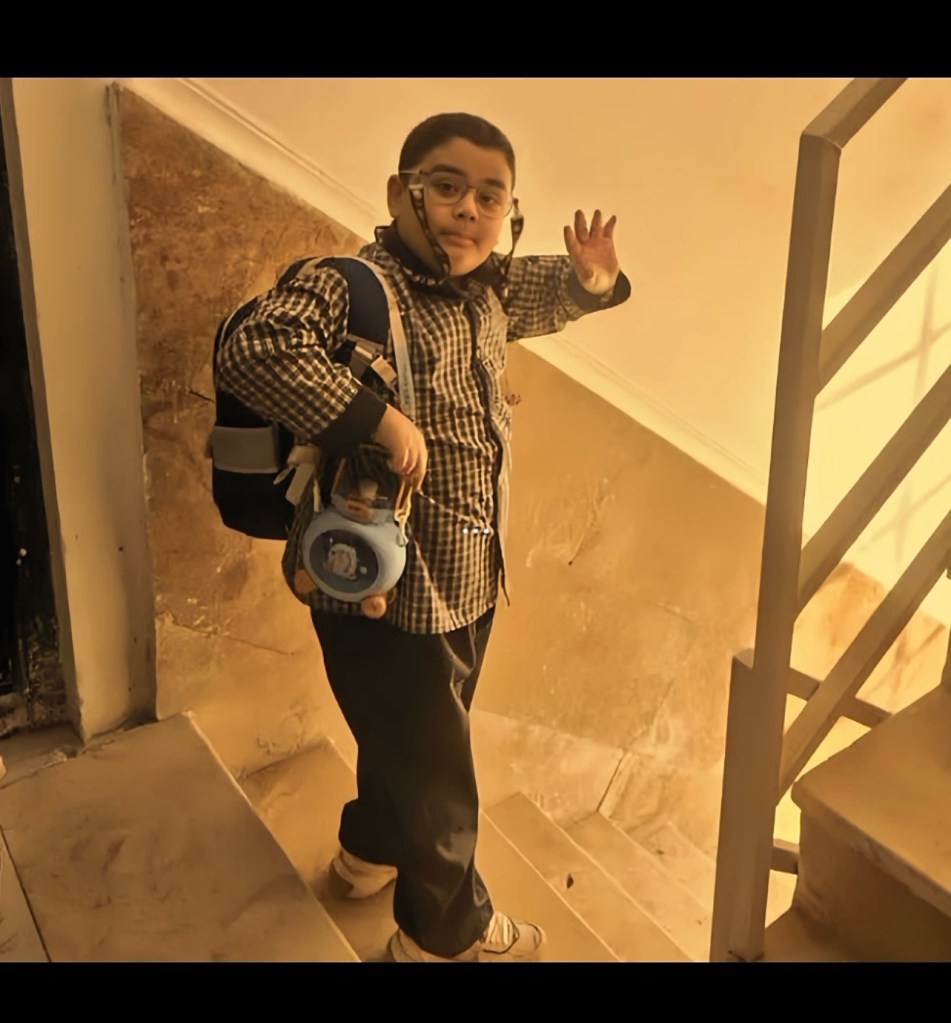
Here’s what I did this morning:
I read Heather Cox Richardson’s summary of the news while waiting for my 17yo to get ready for school. Listened to more news while dropping them off. Came home, settled onto the couch for a long, fortifying snuggle with the mastiff that serves as my homeopathic antidote to the news these days. She got into a septic field a week ago and her smell is finally just about back to its normal feral, calming musk. Went upstairs to change out of pajamas while scrolling through Instagram posts about the war: black clouds of oil raining over Tehran; a furious female lawmaker in Spain, decrying the notion that this war is for women when its first act was to kill little girls in their classroom; a one-year-old child being pulled from rubble of a building we’d bombed. And then: the photo above. A little boy waving from a stairwell. He’s chubby, with glasses fixed to his head by an oversized cord, wearing a backpack and a button-down shirt, carrying a silly-looking light blue something—maybe a lunch box, maybe shaped like an anime character—in one hand, the other raised to say goodbye. To his mother. As he left for school in Minab on Saturday morning. He was a third-grader, but now what they found of him is in one of those hundreds of holes carved out by backhoes in rows across the bleak gray field that maybe once grew flowers, but now holds the bodies of a school full of children. I looked at his photo for such a long time, imagining him with his mother at the store, picking out that lunchbox. I imagined her laying out his shirt and making sure he had his glasses, and then standing in the doorway taking his picture because look at him, oh my goodness look at him, and I dropped to the floor and I wept. For his mother, and for all the mothers in Iran, and Gaza, and Sudan, and everywhere, all of us, who love these children so much it makes us literally insane, who put cords on their glasses and treats in their lunches, and all around the world there are sick, selfish men who want to use their bodies for power, for gratification, for leverage, for revenge. I haven’t cried like that in a very long time, but it went on for a while, and then I went downstairs and started this post, but it started again later on, and when I returned to work on this some more, it started all over again. I have been crying about this child all day.
I’m not complaining. Mikaeil’s mother—if she survived the double-tap strike that killed the parents and first responders after it killed the children and their teachers—is laid out by a grief that we all say we can’t imagine, but we can. We do. We imagine it all the fucking time, and that is another thing they don’t tell you about before you become a mother. That the idea, the threat of that grief is a stalker who will follow one step behind you, every day for the rest of your life.
What I’m saying is, on the one hand: this is what it’s like to be an American with any remaining shred of empathy right now. You wake up, you’re reminded that we have become the cruelest bullies in the schoolyard, you grieve, you ask yourself what you can do. You learn things like how a double-tap strike works—and if you don’t know this, let me explain. It’s not just that we bomb something, and then we wait a little while and bomb it again. That’s atrocious, and depraved, but no. We sent a fleet of bombs over this area, and one struck the school, but another circled; it flew around, “gathering data,” watching what was happening on the ground. There were several sites targeted by this little fleet, but only one of them had people in it—the school. And so that last bomb that stayed aloft, observing, it saw the parents and the first responders who were rushing to rescue the children, and it marked them. There, some circuit inside it said, and down it went. We sent a bomb that hung around waiting, and didn’t drop until there were more people to kill.
This.
Is.
Who.
We.
Are.
But on the other hand: my God but it beats the alternative. No one is dropping bombs on my kids right now. The air that I breathe, by the time it circulates all the way to me from Tehran, will be much cleaner. Though we all live inside the same bubble. Those towering columns of petroleum smoke will come for us all, except maybe the shambling husk of our president, whose days on this planet are dwindling.
I feel like, everything that’s happening around us, I see it now: I see how it all fits together, the atrocities detailed in the Epstein files, they’re not just about sex and the carnal urges of powerful men—though that’s in there, certainly—they’re about networking, connecting, and making sure you can keep people on board by holding something over them. These men in power simultaneously demand that women keep doing their work, the work of reproducing, the work of making more little bodies for them to ravage and exploit, while poisoning the world those children are born into, using them for target practice, sending them to war. They wind us up about idiotic boogeymen—trans kids in sports, abortions in the water supply, DEI hires—to keep our eyes off the ball so that a small cadre of the worst imaginable men can amass more money despite already having more than they could spend in a hundred lifetimes. Meanwhile they send children to be raped as insurance policies; offerings for initiation into some sickening club, a blood brotherhood where innocent blood seals the oath. And then they stand on a stage, or they post on their platforms, that this is how we bring Jesus back again, that they are his messengers and his instruments, that this is what he meant when he talked about little children, suffering to come unto him.
I do think I get, now, know why that photo of Mikaeil has stirred such a specific horror for me (and, I suspect, many other American parents). It’s because we Gen X moms (and dads) have spent our parenting lives being regularly reminded that whatever goodbye you get when you drop them off in the morning might be the last goodbye you get. I have a thousand snapshots stored in my mind of each child climbing out of the car in the morning—bounding, slinking, stumbling, swearing—that I saved because there was always a voice in my head wondering aloud whether this was the dreaded day. Because I think I believed on some level that if I noted the possibility, it would pass me by. Like blood on the lintel. Like a prayer.
I don’t know what I can do about this. I don’t know what we can do about this. But I know that we cannot continue this way. Not us, as individual people, not us as a country. And I hope Pete Hegseth sees this child’s face every time he closes his eyes, until the day he dies.
-
Jesus Vs. The Reaper
Well if you haven’t already heard, I’m happy to inform you that my girl got out of the Middle East shortly after I posted about it, and is now enjoying a little downtime in Europe with her dad. In the end, getting out was less stressful and less chaotic than any of us imagined it would be, but I’m surprised by how sad it makes me to think I won’t be returning to Jordan in the spring, most because of the reason why.
I’ve noticed, over the course of the last week, how my news consumption has plummeted. There are benign reasons–I’m listening to a lot more audiobooks this year, and I’ve got a good one going now; also it’s spring, there’s a lot to do outside getting the garden ready–but mostly, it’s the war. While my daughter was still in Amman, I put myself on need-to-know status: taking in the broad strokes, knowing the general status of things, especially in Jordan, but no more than that. It was too much; too close. Now she’s out and I’m not worried for her personal safety anymore, but I still can’t stand the news because it’s just too terrible. What we’ve already done there, and what we seem determined to do, in partnership with a regime that’s still in the process of wreaking a separate genocide, feels unbearable. It was bad enough to know that our bombs and our complicity were wiping out Gaza one family at a time; to know that it is our troops who murdered all those little girls inside their school, while our Secretary of Defense jerks off to the footage and our slurring, behatted president shrugs off the dead as “the bad part of war,” as though any good part exists…it’s more than anyone should have to bear.
I haven’t known a lot of Iranians in my life–two who stand out in my memory are a close friend of my mom’s from my childhood and a comically awful online dating experience I had a few years ago–but Iran is one of my bucket list destinations. I don’t ever expect to make it there, certainly not now, but I looked into how it might be done not that long ago. One of my favorite shows on television right now is “Tehran,” which I have to remind myself periodically is actually an Israeli show, filmed in Israel, because it does an outstanding job of portraying both the Iranian regime and Mossad as terrifying villains; the Iranian people are the heroes of the show, and your sympathies can’t help but lie with them. It’s an excellent example of how storytelling can help us empathize with people we think are different from us, and show us the ways in which we all really want the same things: freedom, safety, a better future for our children. The third season finale aired the night we attacked. I won’t spoil it, but I will say that watching it while knowing what had just happened there in real life was gut-wrenching. I rewatched the whole season over the last few nights, as is my habit when a show comes out one episode at a time, and that finale made my heart hurt.
It all just makes me so angry, and I don’t know who to be angry at: patriarchy? Organized religion? Capitalism? Are they all just different flavors of the same poisonous fruit? The idea that we have a government in this country that professes to call itself Christian and pro-life, while oil rains down on the children of Tehran, and pieces of little schoolgirls lie in mass graves, and billions of dollars that could be feeding the hungry and housing the homeless are wasted, along with the lives and futures of young people here and abroad, so that rich old men can get a little richer before they are, insha’allah, consigned to the hells they deserve…I don’t know what to do with that feeling. I don’t believe in apocalypse narratives; in fact, I think stories of the end times help to justify exactly the kind of nihilistic policies our current administration so adores. Who cares what happens to the planet or its people, when you already know you’re saved? Why should you waste time trying to preserve the beauty and biodiversity of the earth when it’s all going to be laid waste at the second coming? Still, it’s hard to watch the black columns of petroleum smoke rising to the heavens and not feel like you’re watching the end of the world. The president probably really believes he’s God’s instrument, just as Hegseth is telling his generals, and so anything he does is justifiable. The only limit I can imagine on his behavior is the knowledge that there’s no money in the afterlife, but he probably believes it can buy him immortality here–though that rot around his neck suggests otherwise. In times like this, a little part of me kind of wishes the Second Coming story were true. I’ve read the gospels, too, and I know what Jesus was about. I would honestly love to believe he’s on his way–the sooner the better–because he would *not* be happy about what’s happening here. To paraphrase the old bumper sticker, if Jesus really is coming, he’s gonna be pissed.
Sadly, I also don’t believe in Jesus as supernatural hero or master of the universe. I recognize he gives a lot of people hope, and that’s great, especially when those people actually feel motivated to embody the message of peace and love that he espoused, unlike the blasphemers currently running our country who can’t shut up about him. But you know who I do believe in? The Grim Reaper. Death, I have total confidence in. He’s got a plan for every one of us, even the most powerful men on earth, and my faith in him gives me hope. Hope that I’m around to finally see what he has in mind for Drumpf.
-
Subscribe
Subscribed
Have a WordPress.com account? Log in now.

